
OrderBridge
A middleware system that connects food delivery platforms to restaurant POS systems - eliminating manual order entry entirely.
At a glance
Project type: Demo projectDemo system based on a real client request- Proposal and integration planning for the client; I designed and built the demo on my own.
- A client needed orders from delivery apps like Uber Eats and DoorDash to go straight into their point-of-sale system. Staff were retyping every order by hand, which is slow and causes mistakes.
- I wrote the proposal and planned the integration with the order provider. I then built OrderBridge as a standalone demo of the same idea: it receives orders, converts them to the POS format, sends them on with automatic retries, and shows everything on a live dashboard.
- Every delivery app sends orders in a different format. Menu items must be matched to POS items. A failure must never lose an order.
- In the demo, an order reaches the POS in under a second with no manual steps. Orders that fail are flagged for a person to review instead of disappearing.
These figures come from the demo system, not a live restaurant.
Every time an order arrives from DoorDash, Uber Eats, or Grubhub, someone at the restaurant has to manually read it off a tablet and type it into their POS system. At 50 orders a day, that's over two hours of labour - every single day.
Manual entry introduces errors. A missed modifier, a wrong quantity, a skipped item. In a high-volume kitchen, one wrong order ripples into customer complaints, refunds, and wasted food.
The economics are straightforward: at 50 orders per day, 2.5 minutes of manual entry each, and $18/hr labour cost - that's over $1,100 lost every month to a problem that should be automated.
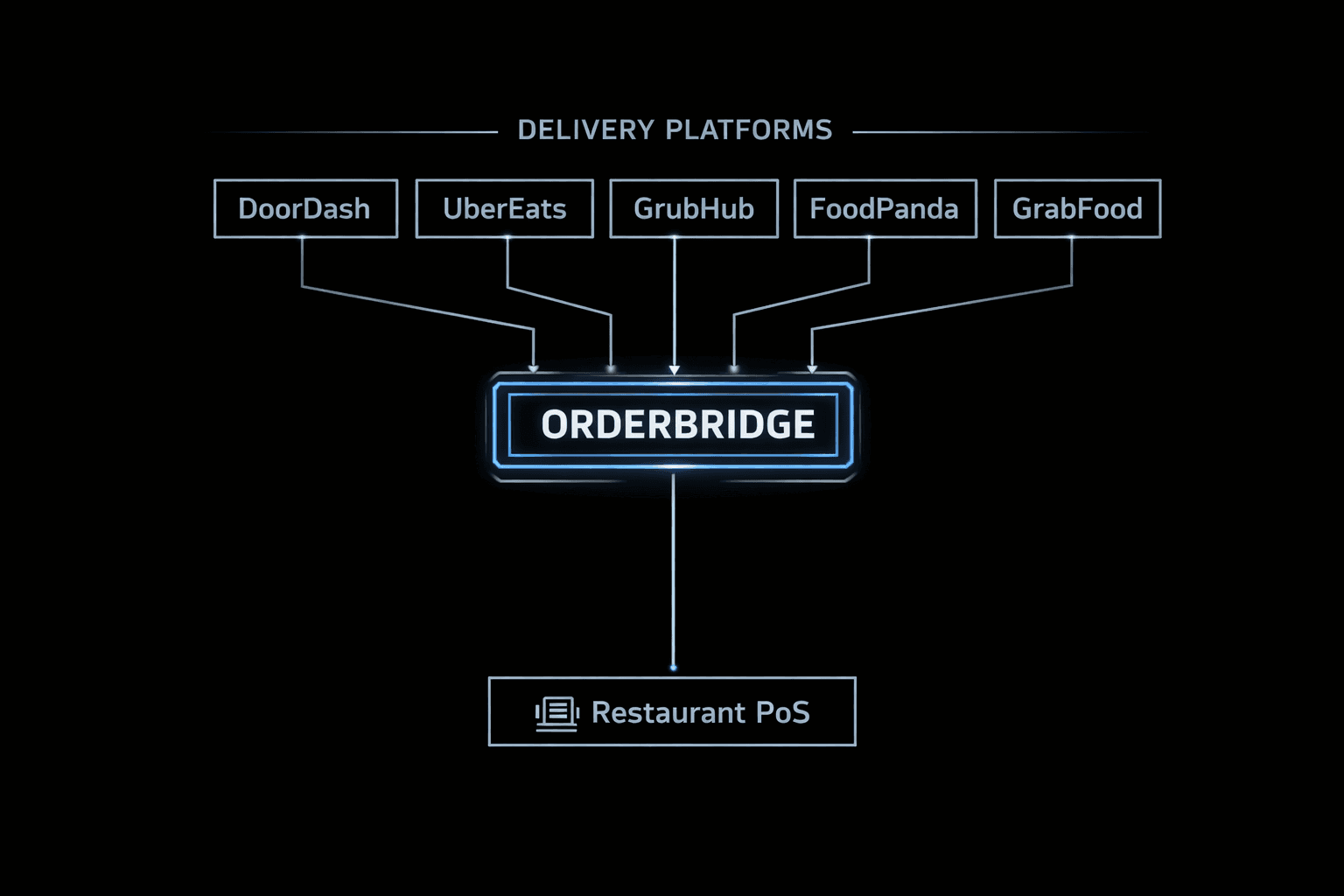
OrderBridge sits between delivery platforms and the POS. When an order arrives, it receives the webhook, translates the payload into the POS format, and injects the order automatically - in under 800ms, with no human in the loop.
Webhook Reception
Each delivery platform sends an HTTPS POST to a shared webhook endpoint. The server verifies the HMAC-SHA256 signature, rejects invalid payloads immediately, and deduplicates by order ID.
Translation
A platform-specific handler maps the delivery schema to a standardised POS payload. Each item is resolved against a MenuMapping table that links platform item IDs to POS SKUs.
Injection
The translated payload is POSTed to the POS API with exponential backoff retry. On success, the POS order ID is stored. On failure after max retries, the order is marked FAILED and flagged for manual review.
Real-Time Sync
Every state change is persisted to PostgreSQL and broadcast via WebSocket to all connected dashboard clients - no polling, no page refreshes.
Fast dev experience, React Query for server state, no SSR overhead needed for a dashboard.
Lower overhead than Express, schema-based validation built in, excellent TypeScript support.
Relational data fits the order/token/mapping schema well. Prisma keeps migrations safe and typed.
Native WebSocket - no Socket.io overhead for a single broadcast channel.
Industry-standard POS auth flow. Tokens encrypted at rest before writing to the database.
Webhook signature verification - only legitimate delivery platform payloads are processed.
Staff retyping data between systems?
If your team copies orders, invoices or customer details from one system into another, I can usually connect the systems so it happens automatically.